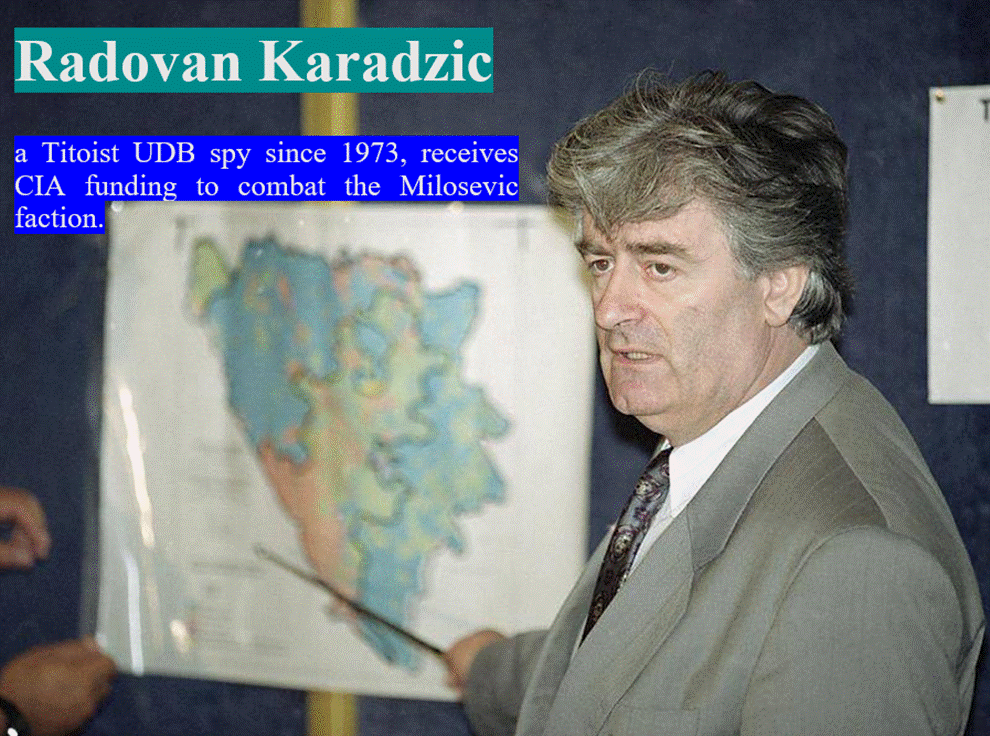
Radovan Karadzic, a Titoist UDB spy since 1973, receives CIA funding to combat the Milosevic faction
Since his recruitment in 1973, Karadzic provided the Yugoslav secret service (UDB) with intelligence on ‘Cominformists’ (communists loyal to friendship with USSR). UDB codename: Agent 309. In the 1990s, the Karadzic group enforced Serb chauvinist terror policies aimed at provoking a Bosnian bourgeois-nationalist insurgency and providing pretext for NATO intervention. The CIA provided financing, the UDB sent troop reinforcements, and Lebanon’s Phalangists provided weaponry for the Karadzic army in these efforts. The Milosevic faction was working day and night to topple the Karadzic regime in Bosnia, a CIA document confirms.
Part of Saed’s upcoming book The History of Class Warfare & Secret Service Conflict in the Greater Middle East.
See also: Hashim Thaci, an agent of the Titoist Yugoslav secret service
See also: Tito's group commits Yugoslavia to a military alliance with NATO
A declassified document of the Yugoslav secret service, UDB, reveals that Radovan Karadzic, codenamed 309, was a spy for Tito’s fascist secret service, providing intelligence on the ‘pro-Russian elements’:
Karadzic, Radovan “309”
As a medical student, he proved to be good. Although he comes from a Chetnik family (his father Vuk belonged to Draža Mihajlović's movement and was sentenced to 15 years in prison as a result), his work with Kosa has influenced him positively. During his studies, he demonstrated himself as very useful and was recruited as a collaborator. He regularly submitted reports under the pseudonym "309," providing updates on individuals he encountered.
As our collaborator, he is excellent and highly conspiratorial. In his work as a collaborator, he has achieved success and can achieve success in unraveling highly educated hostile elements. He is unusually persistent in this, continuing until the completion of the processing he is focused on. Through him, we have had excellent results in developing insights into both hostile reactionary Muslim elements and sympathizers of MM (presumably an organization or movement), among highly educated circles. He has demonstrated his ability as a collaborator and, at the same time, the objectivity of everything the enemy said before him. He has been very useful in our efforts to uncover reactionary Muslim elements in various circles.
Also, as our collaborator, he has succeeded in discovering reactionary groups of anarcho-liberal and pro-Russian elements with an orientation hostile to the politics of the League of Communists of Yugoslavia.
As such, he can be excellently used in scenarios where he can operate entirely as an agent.
As for his safety as a human being, we are convinced that he does not have anything hostile with him now. In our opinion, the officer who will be working with him needs to be educated in the spirit of today, given that he is a young highly educated and gifted person, and in addition, he is by nature emotional and prone to poetic thinking.
Sarajevo on March 12, 1973.
(‘Karadzic, Radovan “309”’, UDB, Sarajevo branch, March 12, 1973, p. 1. This document was found by Bostjan Marko Turk, a Yugoslav politician and journalist, professor at the University of Sorbonne and University of Ljubljana, and a member of the European Academy of Arts and Sciences)
As the UDB was the ally of the CIA, all the more naturally, Radovan Karadzic received CIA funding for his UDB activities in the 1990s. The CIA funding of Karadzic has been confirmed by the CIA official Robert Baer, who helped manage the CIA’s program on Yugoslavia:
Robert Baer Robert Baer, a former high-ranking envoy and CIA officer, is also the author of many works in which he disclosed information about the CIA and the administrations of Bill Clinton and George Bush, for which he was arrested and detained several times. A personal friend, Mitt Waspurh, who worked in the senate and who gave him some information, was shot dead in the hotel. As a senior CIA operative, he worked on the territory of Yugoslavia in the period from (1991-1994) and in the Middle East. Robert Baer participated in several documentaries on National Geographic accusing the Bush administration of the oil war!
The interview was conducted live in Canada, during my trip a few days ago. Robert Baer is currently promoting his book - The secret of the White House - in Quebec, where we spoke. In the interview, we talked about the background of the war in Yugoslavia.
EXCLUSIVE INTERVIEW.
(…).
[Q:] Can you name the politicians who were paid by the CIA in the former Yugoslavia?
[A:] Yes, although it is delicate. Stipe Mesić, Franjo Tuđman, Alija Izebegović, many advisers and members of the Yugoslav government, were paid as were Serbian generals, journalists and even some military formations. For a time, Radovan Karadžić was also paid, but he stopped taking help when he realized that he would be victimized and accused of crimes in Bosnia. This was done by the US administration.
(The End of Yugoslavia: An Interview with Robert Baer, published in Moje Novine, interviewer: Miloš Ćupurdija, September 6, 2012)
Funded by the American imperialist secret service, the Titoist Yugoslav intelligence agent Radovan Karadzic engaged in Greater-Serbian chauvinist terror against the Bosnian people. The goal of such provocative terror operations was (1) provide the Anglo-American imperialists with the ‘humanitarian’ casus belli for intervention, (2) to provide the Bosnian fascists, including the Bosnia branch of Al-Qaeda, with the pretext for launching an insurgency, ostensibly directed against the Karadzic gang but actually directed against the Milosevic faction, and (3) to sow ethnic tension as a way to prevent the consolidation of the alliance of the progressive forces in Bosnia and Serbia, so that Al-Qaeda comes to rule the former Yugoslavia.
Keen on establishing a united front of the Bosnian and Serb anti-colonial forces confronting NATO, the Milosevic faction was engaged in a 24/7 struggle for toppling the provocative terrorist regime of Titoist spy Karadzic. The Milosevic faction purged the Titoist agents of Karadzic in mainland Serbia, confronted the Serb chauvinist oppositionists, and imposed arms embargoes upon and supported various intrigues against the Karadzic regime in the Serb territories of Bosnia. Below is an excerpt of a CIA document confirming the Milosevic faction’s conflict with the Titoist network led by Karadzic:
Serbian President Milosevic continues to work to undermine the Bosnian Serb leadership but probably has little additional leverage now to compel them to sign the Contact Group peace plan. In response, Bosnian Serb leaders Karadzic and Krajisnik are shoring up their internal support and publicly insisting that the' international community guarantee Bosnian Serb sovereignty or reopen discussions of the map--conditions unacceptable to the Bosnian Government. Meanwhile, Milosevic is consolidating his support at home and in the Contact Group which should bolster his ability to squeeze the Bosnian Serbs.
Milosevic Puts the Squeeze on the Bosnian Serbs
Milosevic has continued the public pressure on the Bosnian Serbs he began in early August.
The government-controlled Serbian press continues to condemn the Bosnian Serb rejection of the international peace plan and has recently reported on disagreements and disunity within the Bosnian Serb leadership. As a tactic to increase Karadzic's paranoia, a Belgrade newspaper with ties to Milosevic's wife, published a scenario for the Bosnian Serb leader's overthrow.
* With the exception of Seselj's radicals, Serbia's major political parties are publicly supporting the Contact Group plan and criticizing the Bosnian Serbs. Milosevic orchestrated a vote of support in the Yugoslsav Assembly for his hardline against the Bosnian Serbs.
Milosevic appears to be serious about preventing prohibited goods from entering Bosnian Serb areas in order to pressure the Bosnian Serbs to accept the Contact Group map. Although Milosevic is probably aware of the magnitude of the leakage, we have no hard evidence that he is directly involved in arranging violations. Sarajevo consistently has alleged that Belgrade continues military support to the Bosnian Serbs, however, Bosnian Prime Minister Siladjzic, normally a tough critic of the Serbian President believes Milosevic had made a genuine effort to close border and would seek to replace Karadzic if he remained obdurate. The Bosnian Serbs have reacted with surprise and indignation at Milosevic's action.
* Karadzic publicly blamed Milosevic's blockade for the losses the Bosnian Serb Army suffered to the Bosnian Government around Bihac and Kupres.
Bosnian Serbs Remain Stubborn
Despite these pressures, the Bosnian Serbs are maintaining their defiant, intransigent stance, especially by disrupting relief efforts.
* Karadzic responded last month to a public appeal by Milosevic to end the war by stating that the international community is wasting its time waiting for a positive response by the Bosnian Serbs.
* The Bosnian Serb Army is vigorously pursuing a counteroffensive in the Bihac area, attempting to eliminate government forces in the region.
* The Bosnian Serbs have also denied UNPROFOR requests for fuel convoys and convoys carrying winterization materials to the eastern enclaves, attacked a humanitarian convoy in Goradze, and hijacked a medical convoy outside Sarajevo, and have stepped up harassment attacks on the city-- including an attack on the Holiday Inn housing US diplomats and other foreigners, according to Embassy and press reporting. The Bosnian Serbs also continue to disrupt efforts to reopen the UN-prtecre roaha connects Sarajevo to the rest of federation territory.
Karadzic also has strengthened his grip over Bosnian Serb levers of power.
* Karadzic fired his interior minister, who reportedly had ties to Milosevic, and orchestrated the ouster of two party officials, at least one of whom the press says supported Milosevic's blockade of the Bosnian Serbs.
* Karadzic also replaced the director of the Bosnian Serb radio and TV, and assumed firm control of the media.
In press interviews, Karadzic has shown interest in negotiating territorial swaps with the Muslims but on terms that conflict with Bosnian Government preferences and Contact Group thinking.
* Karadzic plans to ask former President Carter to help negotiate the division of Bosnia. Earlier this fall, Karadzic advocated "Camp David-style" negotiations, with the US and possibly Russia as mediators, and indicated a willingness to trade territory around Sarajevo for the eastern enclaves.
Options for Milosevic
Milosevic wants to rein in the Bosnian Serb leadership because he views Karadzic as an obstacle to solving the current impasse over Bosnia and as a rival who has interfered with Milosevic's efforts to consolidate control.
* Milosevic's strong personal dislike for Karadzic has been aggravated by Karadzic's defiance of Milosevic's wishes – for instance with his offensive this s ring in Gorazde and with his rejection of the international peace plan. In addition to Karadzic, Milosevic probably would also have to replace Bosnian Serb Army Commander General Mladic and Bosnian Serb "Assembly President" Krajisnik, who hold views similar to Karadzic and are at least as powerful.
Milosevic may have considered replacing Karadzic with Mladic, Mladic told Milosevic that he was unwilling to sacrifice Bosnian Serb goals.
* Although he is finding the overthrow of Karadzic to be a complicated task, Milosevic reportedly is considering several options.
* Milosevic recently discussed with Bosnian Serb opposition leaders either a military overthrow of Karadzic or a more peaceful political method to oust the Bosnian Serb leader.
* Bosnian Serb Vice President Koijevic reported an attempt last month to assassinate Karadzic, probably by two former members of a security force that Karadzic had created then disbanded, probably because of its ties to Serbia's secret police.
* Milosevic also could tighten sanctions against the B an Serb we have no evidence he has considered doing so.
Next Steps
Milosevic is continuing to consolidate his support at home and in the Contact Group in ways that bolster his ability to pressure the Bosnian Serbs.
* Milosevic continues to work to marginalize the nationalist opposition, install his supporters in the hierarchy of the Yugoslav Army, and tighten his control of the media.
* Most notably, he has jailed his biggest rival, Vojislav Seselj, because of Seselj's efforts to undermine Milosevic's approach toward the Bosnian Serbs. The loosening of sanctions Milosevic received in exchange for allowing international observers on the border almost certainly has boosted his popular support.
* Milosevic also retired and reappointed generals in the Yugoslav Army, apparently weeding out some senior officers who had not shown loyalty to his break with the Bosnian Serbs.
* Belgrade reportedly has begun to pressure the non-governmental media both financially and politically to be more responsive to its policies, according to the US Embassy.
* Meanwhile, most Contact Group members advocate a further easing of sanctions against Serbia. Russia argues that the international community should lift the remaining sanctions and normalize relations with Belgrade in order to show the Bosnian Serb leadership the benefits of accepting the peace plan.
*Milosevic almost certainly hopes Moscow will block any international effort to require Serbia to recognize Bosnia and Croatia's international borders in order to get further easing of sanctions--a step Milosevic reportedly told Russian Deputy Foreign Minister Churkin recently he is unable to take.
Milosevic also probably believes that his more cooperative stance is encouraging the Contact Group to modify their peace plan.
* French Foreign Minister Juppe has publicly called for a summit between Milosevic, Izetbegovic, and Tudjman. Juppe also recommended allowing the warring parties to make mutually agreed changes to the map.
* France and the UK have pressed for "equal rights" for the Bosnian Serbs to confederate with Serbia. At its ministerial late last month, the EU endorsed "balanced treatment" for the Bosnian Serbs and the Contact Group apparently has signed on to this approach.
(The Milosevic-Karadzic Break: Stalemated For Now: Intelligence Report, CIA Directorate of Central Intelligence, Office of European Analysis, Interagency Balkan Task Force, November 23, 1994)
The Titoist Yugoslav intelligence operatives had a Lebanese connection. The Phalangist ‘Lebanese Forces’ provided their armaments to the Scorpion Squads founded by UDB official Jovica Stanisic, a foe of the Milosevic faction. The Scorpion Squads assisted the Bosnian Serb Army, the Titoist military force of the Karadzic gang, and launched provocative terrorist attacks against Bosniaks, again with the objectives of (1) inviting NATO’s ‘humanitarian’ intervention for war against the Milosevic faction, the faction opposing the Titoist assassins Karadzic and Stanisic, (2) sowing inter-ethnic tensions so to prevent the consolidation of the covert coalition of the anti-colonial Bosniaks and Serbs against NATO and latter’s Titoist allies, and (3) providing the Al-Qaeda insurgents the ability to take over Bosnia after having prevented the consolidation of the Serbian-Bosnian anti-colonial alliance. On the Phalangist funding of the Titoists, Bashar Al-Laqis, a columnist of the prominent Lebanese leftist newspaper ‘Al-Akhbar’, wrote for the Al-Khandak Newspaper:
On the morning of January 19, 1991, Al-Hayat newspaper revealed news that Lebanese militias had supplied weapons to Serbs and Croats in Yugoslavia. The newspaper said at the time that Serbian forces tortured “Lebanese Christians” who handed over weapons to the Serbs after they learned that other Lebanese Christians were supplying weapons to Croatian forces. Members of the Lebanese Forces were beaten and tortured after the Serbs heard that one of the Lebanese Christian parties had sent a ship named “Zenobia 1,” loaded with three tons of ammunition, rocket launchers, artillery pieces, and machine guns, to their Croat opponents by one of the Lebanese Christian organizations. Al-Hayat said that the Serbs released members of Samir Geagea's [Lebanese] Forces after an investigation revealed that a rival Lebanese Christian group was behind arms shipments to the Croats. Al-Hayat said, "Twelve commercial ships believed to be owned by Cypriots transported military supplies from the Lebanese ports of Jounieh and Beirut."
According to an investigation by Steven Engelberg and Eric Schmidt at the time, an arms dealer close to “Christian militias” said in an interview in Beirut that the arms smuggling took place through a front company in Nicosia, Cyprus. Payments from the Serbian side, ranging between $50 million and $70 million per shipment, are transferred to a bank in Paris.
On the eve of August 25, Serbian forces began to impose a stifling siege on the Croatian (Catholic) city of Vukovar in Eastern Slavonia. The siege lasted for nearly three months and ended with Serb forces storming the city on November 18, 1991.
Vukovar was defended by 1,800 small-armed soldiers from the Croatian National Guard and some local volunteers against 36,000 Serb soldiers. During the battle the Serbs adopted a "scorched earth" policy. The Serbs fired about 12,000 shells and missiles into the city a day for three months. Vukovar was the first major European city to be completely destroyed since World War II.
When the city of Vukovar fell on November 18, 1991, hundreds of soldiers and civilians were slaughtered by Serbian forces, and at least 31,000 civilians were forcibly displaced. The weapons sent by the "[Lebanese] Forces' Militia" were not unrelated to what happened in Vukovar. The [Lebanese] Forces' weapons had various roles in that war, including the Serbs using this force to orchestrate the Srebrenica massacre in 1995. On the eve of July 11, the paramilitary Scorpions Squads, affiliated with the Bosnian Serb forces led by Ratko Mladic, began its attack on the town of Srebrenica - adjacent to the Drina River in northeastern Bosnia and Herzegovina - in one of the largest genocides since World War II. Between July 11th and July 22nd of that year, around 8,372 men, women, and children were killed in Srebrenica. The majority of the victims were Bosniak Muslims.
(‘Forces’ Corps: The Ongoing “Nightmare of Darwin”’, Al-Khandak Newspaper, authors: Hussein Assaf, Bashar Al-Laqis)
Some sources strongly deny the mortality and weaponry statistics provided by the above source. I do not know much about those statistics and thus can neither confirm nor deny the claims made about the statistics. Regardless, what is of concern here is that the Titoist ‘Scorpion Squads’, in an alliance with the Titoist army of Karadzic, launched the massacres against non-Bosnian civilians for enforcing the NATO-Titoist objectives mentioned previously. After the above-mentioned massacres, NATO won the pretext for further aggression, Al-Qaeda was able to take over parts of Bosnia, and the Ustase-inspired army of the Titoist Yugoslav commander Franjo Tudjman was able to conquer Croatia.
Click here for Screenshots of Source Documents
_________________________________
Join Mailing List by
emailing sovinform.tech@gmail.com
Place the following phrase in your
email subject/title ‘Join Mailing List’.
No further comment necessary.
_________________________________
Follow Sovinform on
_________________________________
The book The History of the USSR & the Peoples’ Democracies
is now available for easy print.
_________________________________
Karadzic original image. https://www.canberratimes.com.au/story/7250540/karadzic-to-spend-life-in-uk-prison-govt/