The Iraqi Regime’s Ethnic Cleansing campaign against Kurds during Iran-Iraq War – as documented using Iraqi Ba’athist and Iraqi Mukhaberat mercenary sources
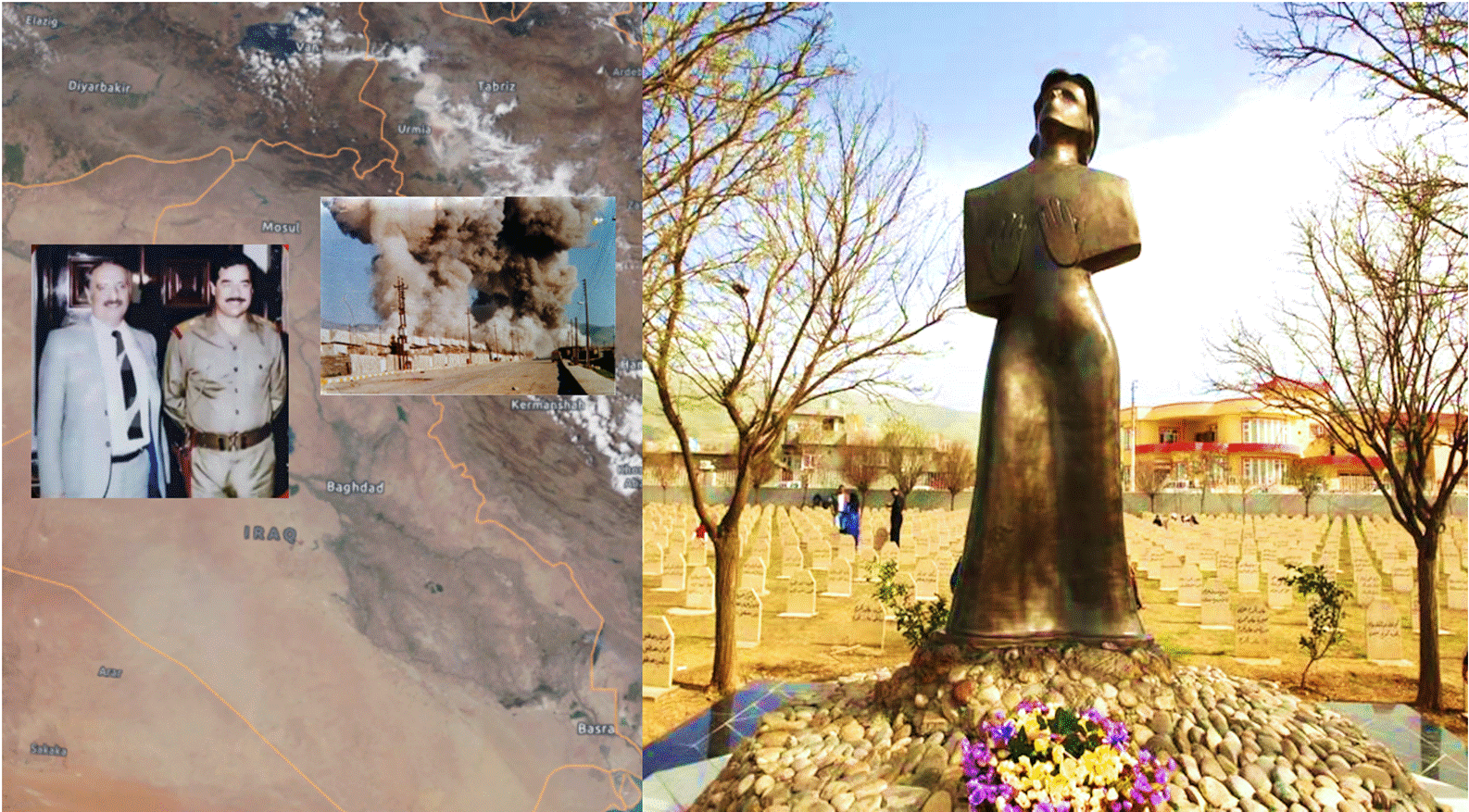
Part of Saed Teymuri’s upcoming book The History of Class Warfare and Secret Service Conflict in the Middle East
By many measures, the best source on the Iraqi regime’s genocide against the Kurds is the ‘Kurdistan Democratic Party – Iran’ (KDP-Iran) leadership. An army of Kurdish fascist mercenaries on the payroll of the Iraqi intelligence, the KDP-Iran led by Dr. Abdel-Rahman Qasemlou and his hangmen openly collaborated with the Ba’athist Iraqi military in the war on Iran. They were the mercenary Kurdish army that fought on the side of the Iraqi regime against Iran. Yet, even as they tried their best to place the blame for the atrocities against Kurds on Iran, they still could not deny the undeniable, namely that the Iraqi regime was carrying out the ethnic cleansing, the destruction of the Kurdish villages, and the gassing of the Kurds.
Qader Worya, a KDPI Politburo member and head of its branches, presented documentary evidence showing that Abdel-Rahman Qasemlou condemned the gassing of Halabja, implicitly holding the Iraqi regime responsible, while still attempting to divert the attention away from the Iraqi regime and onto Iran. The implicit nature of the placement of responsibility on the Iraqi regime and the explicit attempt at deflecting the blame onto Iran renders this source more valuable, for it shows the bias of Qasemlou in favour of the Iraqi regime and against Iran. And yet, even with such a bias, the condemnation of Iraq’s regime was made. An excerpt of Worya’s article is as follows:
(Some evidence to answer those who attack Dr. Qasemlou in connection with the chemical attack on Halabja)
(…). However, unfortunately, some opportunists and sad-hearted individuals … despite knowing these facts, from time to time fall back and accuse Dr. Qasemlou of the great crime of casting suspicion on the Iraqi state’s bombing of Halabja. I remembered that I had heard a report on BBC Radio in which Dr. Qasemlou had condemned the chemical bombing of Halabja. Therefore, these days I did not give up and began to examine the “World Radio News Bulletin” (for 1988) prepared daily by the Party Press Commission. I found these two examples among them. I will try to get the issue of the magazine “Kil el-Orb” which contains an interview or report on Dr. Qasemlou's views on the Iran-Iraq War and the chemical bombardment of Halabja, showing that Dr. Qasemlou did not deny the Iraqi state’s chemical rain in Halabja.
The following are the contents of the interviews and reports that testify to Dr. Qasemloo's condemnation of the chemical crime:
BBC Radio News Program at 6:00 A.M. on September 20, 1988
News Summary: Dr. Abdulrahman Qasemlou, the leader of the Kurdistan Democratic Party of Iran, has condemned the Iraqi government for the widespread use of poison gas against the Kurdish community.
"News Explanation: Dr. Abdel-Rahman Qasemlou, the leader of the Kurdistan Democratic Party of Iran, condemned the Iraqi government for what he called the widespread use of poison gas against the Kurdish community. Dr. Qasemlou said in an interview with a BBC reporter in Paris that he personally did not see evidence of the use of poison gas by Iraq in its recent attacks against the Kurds, but he added that he is confident that the Iraqi government was responsible for the bombing of the city of Halabja last March. According to reports, more than 4,000 people were killed in this Iraqi Kurdish city. They died from mustard gas and nerves. Dr. Qasemlou said that the Iranian government has also used chemical weapons against the Kurds of Iran. A BBC reporter reports that the Kurdistan Democratic Party of Iran has received aid from Iraq in the past 8 years.” (…).
The evening program of BBC radio, December 7, 1988
BBC: What about Iraqi Kurdistan? For example, did you condemn the chemical killing of the Kurds?
Dr. Abdulrahman Qasemlou: Yes, we said this before. Yes, indeed, we generally condemned any chemical killing, because Iran had also used it though of course not to the same extent.
BBC Radio Broadcasting Program December 7, 1988
(Dr. Qasemlou and the Condemnation of the Chemical Bombardment of Halabja, Awene, Qader Worya, March 23, 2021. Bold original)
A US intelligence document leaked by the Wikileaks detailed the conversation with US State Department officials and Qasemlou. In the highly classified report, Qasemlou confessed to the destruction of the Kurdish villages, obliterating the Kurdish way of life. The US State Department official noted that Qasemlou, the traitor, ‘seemed unemotional’ about the destruction of most Kurdish villages. Qasemlou further added that only the ‘Jahash’ or ‘Jaash’ – the ‘derogatory’ term referring to the Kurds collaborating with the Iraqi regime in the genocidal campaign against fellow Kurdish people – were given proper housing and other facilities after the destruction of the Kurdish villages. Even in this private conversation, he still tried to deflect the blame onto Iran, but still admitted that Iraq’s regime utilized chemical warfare much more. Below is an excerpt of the US intelligence report:
VILLAGE DESTRUCTION
--------------------------------
15. POLCHIEF ASKED QASSEMLU FOR HIS REACTION TO THE IRAQI CAMPAIGN OF DESTROYING KURDISH VILLAGES. QASSEMLU ACKNOWLEDGED THAT "MOST" VILLAGES HAVE BEEN DESTROYED BUT HE SEEMED UNEMOTIONAL ON THE POINT. POLCHIEF ASKED IF THE CAMPAIGN HAD HAD THE EFFECT OF INCREASING THE NUMBER OF GUERRILLAS AND REFUGEES. HE ANSWERED THAT IT HAD "GREATLY" INCREASED THE NUMBER OF UERRILLAS BUT NEITHER HE NOR TALABANI ENCOURAGED THE IDEA OF REFUGEES INTO THE OTHER'S TERRITORY, BECAUSE OF THE GREAT DIFFICULTY IN FEEDING AND CARING FOR PEOPLE. THE NET EFFECT OF THE IRAQI VILLAGE DESTRUCTION CAMPAIGN, HE ACKNOWLEDGED, IS THE ALMOST COMPLETE DESTRUCTION OF THE IRAQI KURDS' TRADITIONAL AGRARIAN WAY OF LIFE. KURDISH MEN IN IRAQ HAVE ONLY TWO CHOICES, TO GO TO THE CITIES OR TO STAY: IN NEWLY CONSTRUCTED CENTERS WHERE THE ONLY LIVELIHOOD IS TO BE "JAHASH." QASSEMLU SAID THAT THE IRANIANS HAVE SO FAR ONLY DESTROYED 25 VILLAGES, OUT OF OVER SEVEN THOUSAND IN IRANIAN KURDISTAN (AND A CLAIMED KURDISH POPULATION IN IRAN OF SEVEN MILLION), BUT HE COMMENTED, "ALAS, EACH SIDE TENDS TO LEARN BAD HABITS FROM THE OTHER." ONE BAD HABIT THAT HE CLAIMED THE IRANIANS HAVE (#) IS THE USE OF CHEMICUL WEAPONS. "BOTH SIDES DO IT, ALTHOUGH THE IRAQIS MUCH MORE." POLCHIEF ASKED WHETHER, GIVEN THE DENUDED NATURE OF MOST OF KURDISTAN, HELICOPTERS AND OTHER AIRBORNE ATTACKS POSE A SERIOUS PROBLEM FOR THE PESHMERGA. QASSEMLU SAID, "NEITHER WE NOR THE IRAQI KURDS ARE WORRIED ABOUT HELICOPTERS. WE CAN TAKE CARE OF THEM. BUT ARTILLERY IS A SERIOUS PROBLEM FOR US. AND CHEMICAL WARFARE IS A PROBLEM TOO."
(88BAGHDAD855_a, VIEWS OF IRANIAN KURDISH LEADER QASSEMLU, US Embassy Baghdad, To: DIA, Gulf War Collective, US Secretary of State, US Commander in Chief in US Central Command (USCINCCENT) in MacDill Air Force Base (AFB) in Florida, February 16, 1988)
More evidence of his sympathies for the Iraqi regime is provided in the Screenshots section. Qasemlou indeed despised the Arab nation and Iraq, but that in no way contradicted his direct alliance with Saddam Hussein, for the latter was no better in this respect.
Helene Krulich, the wife of Abdel-Rahman Qasemlou, travelled with her husband to the Kurdish territories, and localized her name into ‘Nasrin Qasemlou’. While acknowledging that her partner in crime and in life “was supported by Saddam,” she nonetheless acknowledged that “Saddam's Air Force” engaged in “the bombing of the city of Halabja in Iraqi Kurdistan with chemical weapons … on March 16, 1988,” killing “5,000 people”:
Even the bombing of the city of Halabja in Iraqi Kurdistan with chemical weapons by Saddam's Air Force on March 16, 1988 and the death of 5,000 people did not cause any official protest. One of the first actions of George Bush Sr., after coming to office, was to oppose the Congressional Resolution for the punishment of Saddam Hussein's regime, which faced a presidential veto and was not approved. (A European in the land of the Kurds, Nasrin Qasemlou (Helene Krulich), Place of publication: Erbil, 2013, p. 417)
In relation to the Kurdish movements, this old and repeated realpolitik clause had taken a sad turn during the eight-year war between Iraq and Iran. Jalal Talabani, the leader of one of the two major Iraqi Kurdistan parties, took refuge in Tehran and was supported by the Islamic Republic. Qasemlou also went to Baghdad and was supported by Saddam. Qasemlou and Talabani were friends for a long time. This situation was not a comfortable one, and Qasemlou rarely talks about it. In the conversations we had together at that time, he spoke about this issue only once and that too with self-restraint, and he especially emphasized that the Kurds, who are temporary allies of the two hostile governments, at least, do not hesitate to make any effort to prevent the fratricidal war. (A European in the land of the Kurds, Nasrin Qasemlou (Helene Krulich), Place of publication: Erbil, 2013, p. 417)
25 years after the chemical attack on Halabja, the KDP-Iran mercenaries of the Talfahi Saddamite Ba’athists still obsessively try to deflect the blame onto Iran, despite admitting the Iraqi regime’s responsibility for the massacre. In one of their very rare mentions of the massacre in Halabja, the KDP-Iran’s media organ ‘Kurdistan Media’ published an article by a former KDP-I warlord Majid Haqqi, following the path of Qasemlou and others in attempting to deflect the blame while failing to hide the facts:
Twenty-five years after the chemical attack on Halabja, Iran's role in the attack has rarely been mentioned. Perhaps the reason is that since Saddam's regime committed this terrible crime, the neighboring country that played an important role in bringing the news of this crime to the outside world did not want to hurt the big bear and silence the silent relations.
The chemical attack on Halabja came as the eight-year war between Iran and Iraq was coming to an end. With the support of Western and Arab countries in Iraq, Iran was reducing its urban warfare and its aircraft could not reach the most remote and largest cities of the country and cause more casualties.
Before Halabja, chemical weapons had been used in the war between the two countries since Mustard gas and VX gas, which were available to both Iran and Iraq, were used in the fighting. Interestingly, with the exception of two areas, all chemical weapons and bombs were used only in Kurdistan and Kurdish areas such as Marivan, Bana and surrounding villages, Piranshahr, Nodsheh, Sardasht.
Before the Halabja chemical attack, Iran faced public opposition and internal problems of the Islamic Republic authorities due to its subsequent defeats on the battlefields. To overcome the crisis and to support the mobilization of the Iranian public opinion in the war between the two countries, Iran began to approach the Kurdish forces in practice and took advantage of the opposition of the Kurdish movement in southern Kurdistan to Saddam's government. Relying on the support and advance of the Kurdistan Peshmerga forces, he attacked Halabja and before his forces entered Halabja and occupied the city, the Iranian public media propagated the liberation of Halabja by the Islamic soldiers and the welcome of the people of the city announced.
The Islamic Republic achieved several strategic and political goals by attacking and sacrificing Halabja:
- By encouraging Saddam's regime to chemically attack Halabja, he was able to strengthen his propaganda machine about the use of Saddam's weapons of mass destruction on the battlefields and bring the world's media from Iran to Halabja.
- Using the opposition of the Kurdish people in South Kurdistan, the Kurdish people to become part of the army of the war between the two countries and the Kurds to become victims of this devastating war.
- Attracting Iranian public opinion to support this devastating war.
- Access to water resources in South Kurdistan, especially the Dukan Dam, for military use and when necessary, blowing up these dams for military purposes.
The Islamic Republic of Iran, aware of the high possibility of Saddam Hussein's use of chemical weapons, used Halabja as a tool for its aggressive propaganda.
Today, twenty-five years after that bitter incident, it is appropriate to investigate Iran's role in the chemical attack and massacre of the Kurdish people in Kurdistan.
(Iran's role in Halabja chemical attack, Kurdistan Media, KDP-Iran, Majid Haqi, March 17, 2013)
Much less known is that Ashraf Dehqani’s group of the ‘Iranian People’s Fedai Guerrillas’ also had bases in Iraq and received funding from the Iraqi Mukhaberat, hence her active participation in the war effort against Iran during the Iran-Iraq War. Yet, for what it is worth as a confession, the media organ of Ashraf Dehqani’s group, in attempting to cover up the group’s own role in helping Saddam’s regime, retreated forwards and condemned Saddam’s regime for this genocidal act:
One of the justifications of the United States of America during the attack on Iraq was the stockpile of chemical weapons by that country’s government. Of course, after the occupation of Iraq, it emerged clear that the chemical weapons which the Iraqi government had used against the Kurdish people of this country during the attack on Halabja, had been subsequently destroyed by the Iraqi government with the knowledge of the Great Powers. (Agent Orange Kills and No one has to Pay Reparations, Payam e Fadaei: The Organ of the Iranian People’s Fedai Guerrillas, No. 9, July 2007, p. 99)
A US intelligence document leaked by Wikileaks confirmed that the Iraqi regime engaged in the ‘wholesale destruction of Kurdish villages’:
4. UNFORTUNATELY FOR THE IRAQIS, MUCH OF THE ADDED BURDEN ON MORALE IS DUE DECISIONS AND MISCALCULATIONS BY THEIR OWN GOVERNMENT IN RECENT MONTHS, INCLUDING: -- 1) A MAJOR REAPPEARANCE OF POPULAR ARMY PRESS GANGS AFTER AN ABSENCE OF A YEAR. ONE EXPLANATION IS THAT THE REGIME IS RAISING UNITS TO REPLACE KURDISH TRIBAL IRREGULAR UNITS DOING GARRISON AND REAR-AREA PATROL DUTY, SINCE THESE UNITS ARE CONSIDERED EVEN LESS RELIABLE IN THE WAKE OF THE GOVERNMENT'S WHOLESALE DESTRUCTION OF KURDISH VILLAGES. (THE STREET RUMOR IS THAT THREE-FOURTHS OF THE NEW PA FORCES WILL GO NORTH TO KURDISTAN;ONE FOURTH TO GUARD PIPELINE.) MIDDLE-AGED BAGHDADIS REALLY FEAR DUTY IN KURDISTAN, EXPECTING TO HAVE THEIR THROATS CUT IN THE DARK OF NIGHT. ANOTHER EXPLANATION IS THAT AFTER A YEAR OF RECRUITING INACTIVITY, MANY PA UNITS ARE DUE TO BE DEMOBILIZED AFTER THEIR FOURTEEN MONTHS DUTY PERIOD AND MUST NOW BE REPLACED WHOLESALE. (88BAGHDAD1177_a, THE REGIME IS PART OF THE PROBLEM, From: US Embassy Baghdad, To: US Secretary of State, March 2, 1988. Bold added.)
Iraqi Arab Ba’athist regime sources acknowledge aspects of the regime’s policy of ethnic cleansing against the Kurds.
The Thiqar, the media organ of Izzat Al-Douri’s Talfahi Saddamite Ba’athist movement after the 2003 US invasion, firstly claimed that the Iraqi regime frequently requested the Kurds of Iraq to leave their villages on their own. The Kurds remained in their land. After the ‘failure’ of the Kurds to leave their villages, the Iraqi regime, as confirmed by Thiqar, embarked on the mass deportation of the Kurds, ostensibly to ‘protect’ civilians from harm:
Instead of standing with the cause of their people and defending it as part of the fabric of Iraq's national identity, and instead of recalling Iran's betrayal in 1975, Kurdish politicians have opened a record filled with conspiracy, ingratitude, and denial of the interests of the Iraqi people, including their fellow Kurds. They supported the Iranians, not just once, to achieve numerous penetrations and interference in the trenches, enabling them to occupy various areas during that period, including the region of Halabja and other mountainous areas.
To prevent our people from the harm of this war due to clashes between the Iraqi and Iranian armies, the Iraqi government requested from Kurdish politicians, and distributed statements to the residents of those areas, urging them not to shelter the Iranians. The government repeatedly requested the evacuation of those areas. On this basis, and for these reasons, the government, through army units, carried out the deportation operation, fearing harm to civilians.
The Kurds who moved and temporarily settled in our regions lived among their people. Some of them even assumed roles and became accustomed to life there. Some no longer consider returning because they feel secure and liberated from the control of parties, according to some reports. This is how these politicians played their role, a history filled with blood, conspiracy, and collaboration with foreign intelligence.
(The Truth about the “Oppression” of the Kurds, Thiqar, Al-Mansour Network, League of Al-Ahl Al-Haqq, Nasir Al-Sheikh, February 17, 2010)
Another who wrote of the mass deportation of the Kurds and the levelling off the Kurdish villages was Nizar Al-Khazraji, the Chief of Staff of the Iraqi Army during the years of the Iran-Iraq War, a loyal agent of Saddam Hussein all the way until Saddam’s 1989 defection to the anti-imperialist camp, a blatant apologist for the mass deportations of Kurds and destruction of their villages, and an explicit denier of the Iraqi regime culpability for the Halabja Massacre. In his memoirs, he correctly remembered that Saddam Hussein trusted Nizar and considered him a Saddamist:
I began to speak honestly, confidently and objectively about the details of what I know and his positions towards us Baathists, his love for us and his admiration for us for the courage and sacrifice we showed for the sake of the homeland, and what he was accused of, and my deep and firm convictions of his innocence. Saddam was listening with interest and concentration and shaking his head as if urging me to continue. When Comrade Al-Shaikhli objected, “We noticed that he was looking at us with threatening looks on the occasions when he met us.” I replied, “Do you really believe that whoever wants to conspire and overthrow you will do so with his looks whenever he meets you, or is the opposite true?” "All that matters is that the Ansari's eyes are wide and squint a little when he thinks or is absent-minded for a moment, and this is what made you and others also come out with such an impression."
Comrade Saddam commented by saying: "He who conspires against us does not threaten us with his glances. I hope you will continue your talk, Comrade Nizar." After more than half an hour, I had said what I wanted. Comrade Saddam continued: "I am convinced by what Comrade Nizar said, although we know that many disgruntled officers were visiting him at the time and they turned him against us somewhat." He continued in his speech: "Let me explain this to you better. Ansari is like a blank sheet of paper, and if you write on it with an alpha-pen, you will notice that this happens to others," for the man does not know hatred and malice. I confirmed: "Never."
Saddam finally said: "Comrade Nizar, I personally heard about you. "I knew you were a Saddamist, a Baathist and a committed person, but now you have added something else to us. It is a pity that someone like you is here while the country needs you and we need people like you with us. You will return soon and see al-Ansari free and at liberty." He paused for a moment and then added, "Of course, after we take the opinion of the comrades in the leadership," but I say that you will hear good news.
After his return from the guest house where Saddam lived, Fadhel al-Barak came to me and said, "Congratulations, brother. You have left an excellent impression on the comrade deputy. He admires you. I was pleased by his saying this."
(Iran-Iraq War 1980-1988: The Memoirs of a Warrior, Nizar Al-Khazraji, 2014)
Only after Saddam’s 1989 defection did Khazraji’s relations with Saddam begin to deteriorate, but even then, he continued to defend Saddam’s track record until 1990, as in his book and his public statements. Further, in his memoirs, Nizar Al-Khazraji explicitly blamed Iran for the Halabja massacre and denied Iraqi regime responsibility. He also wrote extensively about the destruction of the Kurdish villages and the ethnic cleansing (‘deportation’) of Kurds. Below is what he wrote of the matter:
The First Corps suffered in its operations to combat Kurdish militants from the presence of border villages as hideouts and safe areas for saboteurs, smugglers, and foreign collaborators on the other side of the border, and from other isolated villages or in impregnable areas within and deep within the areas of operations to which Kurdish militants resort, and some of which constitute forward launching bases from which they depart. To launch their sabotage operations. Thus, the Corps generated a plan that was supported by the Chief of Staff and presented to the political leadership, which approved it and ordered it to begin its implementation, as many countries had previously faced similar operations. Thus the work was completed brilliantly, which was to evacuate the border strip from the villages and prevent population presence there to a depth ranging between 15 and 25 km, as well as in isolated villages in the interior. The residents were transferred to complexes that had all the requirements, after compensating them for their homes, farms, orchards, and animals in a rewarding manner, to flat and close areas that could be easily reached by the civil administration and security forces. Their return to their previous areas would be gradually reconsidered in light of the state’s success in ending sabotage movements in the Northern Iraq region.
The civil administrations advised the military commanders in their departments to determine the locations of the complexes, and the decision was based on their size and category:
small, with a capacity of 500 to 1,000 houses,
medium, with a capacity of 1,000 to 1,500 houses,
large and has a capacity of 1,500 to 2,000 houses,
all of which can be expanded when needed. Then it began providing contracts to build housing and infrastructure, including a water and electricity system, schools, clinics, and administration and police centers, and built roads to and within it as well. Committees of specialized personnel were formed in the governorates to assess and evaluate the properties of those displaced from their villages and compensate them. We noted that the compensation was rewarding and more than fair. The division's units secured protection and transported the villagers and the furniture and belongings they carried to their compounds on the wheels of the division's transport companies. The division's engineering assisted the civil administration in the operations of demolishing the villages. And leveling it with the ground so that it will not be a refuge for vandals in the future.
During my visit to some of the compounds after the evacuees had occupied them, I saw most of the men and young men who had been working on their farms and looking after their livestock before the deportation, sitting in groups outside their homes, clearly bored and impatient. There is no agricultural land to work on and no animals to invest in. The land and animals available in the area are hardly enough for its people. The original ones. If they remain like this, they will become ferment ready to be exploited by advocates of armed parties and movements to annex them. Therefore, when I returned to the division command, I gathered all the service commanders in the division, and I mentioned to them the situation in which I had seen the evacuees in compounds and the danger of that. I asked them to prepare special teams under the command of good officers from their units to teach the evacuees the professions that would open up to them fields of honorable work in the compounds and outside them. I called the governor and told him the steps we would take. He welcomed them and expressed his willingness to provide any assistance or service we needed.
(Iran-Iraq War 1980-1988: The Memoirs of a Warrior, Arab Center for Research and Policy Studies, Nizar Al-Khazraji, January 2014, pp. 181-183)
Nizar’s claim that the Kurds were compensated is a great distortion; only the Jaash, the regime-collaborationists, were compensated, as the Iraqi regime’s top Kurdish fascist mercenary Abdel-Rahman Qasemlou admitted. Again, recall the following passage:
THE NET EFFECT OF THE IRAQI VILLAGE DESTRUCTION CAMPAIGN, HE ACKNOWLEDGED, IS THE ALMOST COMPLETE DESTRUCTION OF THE IRAQI KURDS' TRADITIONAL AGRARIAN WAY OF LIFE. KURDISH MEN IN IRAQ HAVE ONLY TWO CHOICES, TO GO TO THE CITIES OR TO STAY: IN NEWLY CONSTRUCTED CENTERS WHERE THE ONLY LIVELIHOOD IS TO BE "JAHASH." (88BAGHDAD855_a, VIEWS OF IRANIAN KURDISH LEADER QASSEMLU, US Embassy Baghdad, To: DIA, Gulf War Collective, US Secretary of State, US Commander in Chief in US Central Command (USCINCCENT) in MacDill Air Force Base (AFB) in Florida, February 16, 1988)
Moreover, from the perspective of military strategy, Nizar Al-Khazraji’s statement that the deportation and village destruction campaigns against the Kurds was ‘necessary’ for preventing Iranian military penetration contains a hidden confession. If the matter at hand was merely the unfavourable terrain of urban and rural areas in the borderlands, why did the Iraqi regime target Kurdish homes in especial, and not seek the wholesale destruction also of almost all Iraqi Arab cities and villages closer to Iran? Such a discrimination indicates that the Iraqi regime was focusing on the Kurdish areas not merely for the treacherous terrain of urban and rural areas, but because of unique aspects of Kurdish society. The implication was that the Kurdish society bore a hostile anti-Saddamite cultural-political trend that rendered it a target for the Iraqi regime security.
Moreover, the treacherous urban terrain of the urban areas could be utilized by the Iraqi regime for combat against the Iranians, if the population in the urban areas would be supportive of the Iraqi regime forces, welcoming the latter in their homes. Had the Kurds of Iraq been sympathetic to the Talfahi regime, the latter could safely deploy its troops onto Kurdish villages so to garrison them. Yet, the Iraqi regime did not do so, precisely because the Kurds living in Kurdish villages and cities were antagonistic towards the regime, implying that the deployment of Talfahi regime forces to Kurdish villages would lead (1) neither to a garrison (2) nor to a protective immersion among a supportive masses (3) but to the Kurdish freedom-fighters’ ambush of those Talfahi regime troops. As the deployment of regime troops in those areas was not feasible, the best course, from the regime strategy perspective, was to obliterate the Kurdish nation, to the extent strategically feasible, and to level off their towns.
Yet, the destruction of Kurdish villages was an end in itself, for the destruction of the productive forces in Kurdish society could help roll back the influence of the progressive classes that arise with the development of the productive forces, and to strengthen the Kurdish parasitic classes that thrive off of backwards modes of production. It would have empowered the Nazi-Maoist team of Talabani and the rightist gangsters of Barzani. Hence, the Talfahi Saddamite regime, the terror state in service to the parasitic classes, had a natural motivation to destroy Kurdish villages, regardless of its value in direct combat.
By international law, launching gas attacks even at soldiers is considered a great crime. The Talfahi Ba’athi sources admit that the Iraqi regime launched gas attacks in particular, although they predictably fall short of admitting that the regime targeted them at the civilians. Lieutenant-General Ra’d-Majid Al-Hamdani, a prominent commander of the Iraqi Army during the Iran-Iraq War and a close aid to Adnan Khayrallah, admitted to the use of chemical weapons:
On the night of the major attack, Saddam Hussein and Adnan Khayrallah attended our headquarters. They both directed part of the battle from the Republican Guard Operations Room. They assigned their sons (Adi and Qusay) to join the commanders of the Republican Guard and the Seventh Corps. Adi was with the Guard, and Qusay was with the Seventh Corps. (Qusay married the daughter of Major General Maher and had a son named Mustafa. The young man reached the age of men and was named after his father. He martyred alongside his father and uncle after a heroic battle that lasted six hours against hundreds of Americans in Mosul after the occupation of Iraq).
At four thirty in the morning on April 17, 1988, more than a thousand artillery pieces launched the concentrated preparatory shelling, including a strike with chemical weapons. Starting from six o'clock, tanks designated for destroying fortified frontlines participated from platforms specially made for them. The air force and several naval boats also participated in the preparatory shelling phase. We hear through the communications the first signs of victory... The other following units were not late in delivering news of the victory one after the other, and we are in disbelief at the speed of that success... After six hours had passed, all the forward formations were in their targets except for the sector of the 16th Special Forces Brigade, Republican Guard, which was Under the command of then Colonel Talal Al-Qaisi... The water barrier was large and deep... and a very large enemy force was concentrated in front of it... and through the first steps of success, the second leg of the bulwark was pushed back, and through the cutter of the Sixth Brigade, led by Colonel Raad Rashad at the time, the resistance of the Sixteenth Brigade was circumvented... and it was completely destroyed. ...And the armoured brigades began to rush into the depths... By nightfall of that day, all of our formations had completed their objectives for the first page in all their stages... We also received news of victory in the sector of the Seventh Corps, which was fighting in the eastern sector...
(The Battle for the Liberation of Al-Faw, Lieutenant-General Ra’d-Majid Al-Hamdani, April 17, 2020. Bold added)
The Jordanian Ba’ath also has made the same confession.
As is well-known, in Palestine and Palestinian-majority Jordan, Saddam Hussein has long enjoyed great popularity. This itself has awakened many Kurds about the Palestinian threat, giving rise to a more reasonable attitude towards Israel, something that many in the Palestine-fetishist leftist circles lack; it has also given the fools and reactionaries in Iraqi Kurdish society the pretext to express sympathies for reactionary circles in Israel, the same who were covertly supporting the Iraqi regime during the Iran-Iraq War (see chapter #).
In Jordan, the hostile current of Saddamism has led to the thriving of the so-called ‘Arab Socialist Ba’ath Party of Jordan’, a staunchly Saddamite party. A waste of time it would be for the reader to bother reading the Jordanian Ba’ath’s praise of Saddam Hussein; but for the record, hereby it is being provided:
April, the month of goodness and giving, the month of love and beauty, where tree buds blossom, and the earth flourishes in its beautiful green dress. Mountains, plateaus, and valleys are adorned with flowers and roses as if painted with various colors that delight the observers. The month of spring, so it's no wonder that the poets express their sentiments in the most beautiful words and descriptions in their poems. In one of his poems, Al-Buhturi says:
"Spring has come, free and cheerful, laughing from its beauty to the point of speaking,
And Norooz warned in the twilight of darkness, the earliest flowers were asleep yesterday."
It's fortunate to be born in this month, specifically on the seventh day of April in the year 1947, the Arab Socialist Ba'ath Party was founded. Its ideas, principles, goals, and slogan became a torch of light and a compass for the Arab masses to follow the path of liberation, freedom, unity, glory, and dignity, creating a unified Arab democratic renaissance society.
On the twenty-eighth of April, 1937, the symbolic leader, the martyr, the hero Saddam Hussein was born. He embraced the Ba'ath ideology since his youth, and throughout his entire life, he embodied the living image of Ba'ath thought, practice, and struggle, forming a laurel wreath and a title of pride and honor for every Ba'athist across the ages.
He truly embodied the words of the founding leader, Comrade Ahmad Meshal Aflaq, who described him as the gift of the party to Iraq and Iraq's gift to the entire Arab nation. It's no wonder that he received love and admiration from the Arab and Muslim masses worldwide, as he was a great and courageous leader who served Iraq and elevated it to the highest ranks among nations. He served his Arab nation, and it's enough that he is the Arab leader who translated the slogan of Arab oil for all Arabs, benefiting the Arabs as much as Iraq did. We in Jordan do not forget the good that came from the Iraqi destiny, even in the darkest circumstances that Iraq faced during the period of siege and war.
(‘Your Birth, Saddam, a Birth of Goodness and Giving’, Arab Socialist Ba’ath Party of Jordan, Muhammad Al-Khaza’aleh, April 27, 2020)
The Talfahi Saddamite Ba’ath of Jordan nonetheless confessed that the Iraqi regime “admitted to using mustard gas”:
The former Iraqi state admitted to using mustard gas against the Iranian army, not civilians. Dr. Mohammad Al-Obaydi raises questions about what happened in the Kurdish city of Halabja. He explores different perspectives, counter-arguments, and the media's use and exploitation of the tragedy in Halabja. Halabja remained distant from the official American position because condemning it would implicate Saddam Hussein, whom the U.S. considered an ally during the Iran-Iraq War. Thus, President Bush avoided mentioning it. While the story disappeared from official and media discourse in the 1980s and 1990s, it resurfaced during Bush's election campaign. (The Former Iraqi Regime Admitted to Using Mustard Gas Against the Iranian Army and not Against Civilians, Arab Socialist Ba’ath Party of Jordan, April 21, 2011)
Dr. Obaydi, who denied the Iraqi regime culpability for the Halabja massacre, nonetheless said:
We are well aware of the use of chemical weapons by both Iraq and Iran against each other during the fierce war that lasted for eight years and ended on August 20, 1988, with the declaration of a ceasefire. (The Former Iraqi Regime Admitted to Using Mustard Gas Against The Iranian Army and not Against Civilians, Arab Socialist Ba’ath Party of Jordan, April 21, 2011)
An Iraqi intelligence report from the Shaqlawah Security, a local branch of the Talfahi regime’s security apparatus, was leaked to Human Rights Watch but was cited by Dr. Obaydi in the article published by the Jordanian Ba’ath. The report is as follows:
The Iranian enemy supplied the families of saboteurs in the villages and border areas with medical drugs, especially medicines against chemical substances. They are trained on the use of blue needles used for this purpose, as well as training on how to wear protective masks on the head.
There are about a hundred saboteurs from various sabotage groups in the Warta region, affiliated with the Qadisiyah district, on the Khanqaw road. This is to confront the force assisting the deportation of villages, knowing that most families in that area have left for Iran.
Please verify the accuracy of the information and inform us within 24 hours, please.
Signature: Security Commander, Director of Shaqlawah Security.
(Shaqlawah Security, issue 2034, dated 10/5/1987. Cited by Dr. Obaydi, taken from an Iraqi intelligence report leaked to Human Rights Watch. In: ‘The Former Iraqi Regime Admitted to Using Mustard Gas Against The Iranian Army and not Against Civilians’, Arab Socialist Ba’ath Party of Jordan, April 21, 2011. Bold added.)
Neither Obaydi, nor Human Rights Watch, nor the Jordanian Ba’ath have any slightest motivation to present Iran in good light. Yet, the above-cited intelligence document serves to indicate that the Iranian armed forces were providing medical supplies to protect the Kurds against chemical attacks and that the Kurds of Iraq were fleeing to Iran. This contradicts the Saddamite allegation that the Iranians were the ones gassing and annihilating the ordinary Kurdish civilians of Iraq. It also shows that the Kurdish freedom-fighters (‘saboteurs’) were confronting the regime’s deportation of village residents.
Click here for Screenshots of Source Documents
_________________________________
Join Mailing List by
emailing sovinform.tech@gmail.com
Place the following phrase in your
email subject/title ‘Join Mailing List’.
No further comment necessary.
_________________________________
Follow Sovinform on
_________________________________
The book The History of the USSR & the Peoples’ Democracies
is now available for easy print.
_________________________________
Image credit: photoshopped version of “A memorial for victims of the 1988 chemical attack is pictured at the cemetery for the victims in the Kurdish town of Halabja, near Sulaimaniya, 260 km (160 miles) northeast of Baghdad, March 16, 2013.” REUTERS/Thaier al-Sudani